
Competencies


Walk through almost any warehouse or plant stockroom, and you'll find the same contradiction. Shelves full of inventory nobody has touched in a year, and a customer order, production line or service job waiting on the one item that ran out.
It's tempting to blame the planners. But they're usually doing exactly what the system tells them to. The problem is the rules underneath, which assume demand is steady and supplier lead times are predictable. For many materials, neither is true.
Most planning setups treat every material the same way. They take average usage, add a buffer and set a reorder point, using one forecasting method for everything. That works when a material is used steadily. But most inventories hold many materials that aren’t used steadily.
Demand planners commonly sort materials into four patterns, based on two questions: how regularly is the material used, and how much does the amount used vary?
Monthly usage over a year for each demand pattern. (Illustrative)
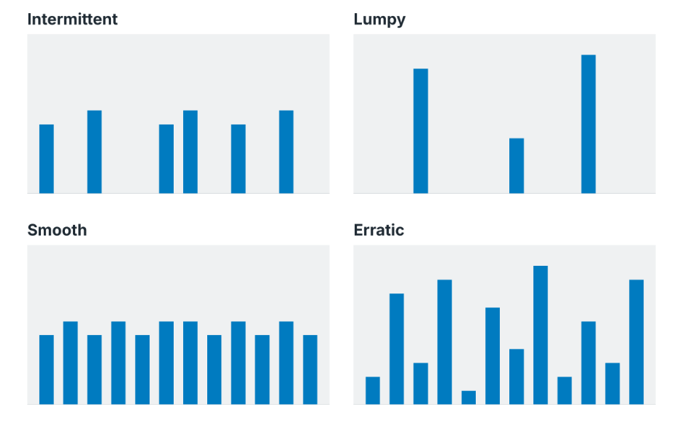
Forecasting methods built for smooth demand rely on averages. That's why they don't work for the other three patterns. With intermittent and lumpy demand, most months show zero usage, so the average sits far below what's needed when demand arrives, and far above what's needed the rest of the time. These methods also read months with no usage as a sign that demand is falling, so the forecast drops and stock runs short when the material is suddenly needed again. With erratic demand, the amount swings so widely that the average rarely matches any real month.
A reorder point is only as good as the numbers behind it. Those numbers change: usage rises with a new shift, a machine is retired, a supplier slows down.
Lead times are the clearest example. If a supplier's lead time moves from 8 to 12 days, the right reorder point might move from 600 units to 800. Keep ordering at 600, and you're 200 units short before the next delivery arrives. Multiply that across thousands of materials. The system keeps ordering on numbers that no longer match how materials are used or how long suppliers take to deliver.
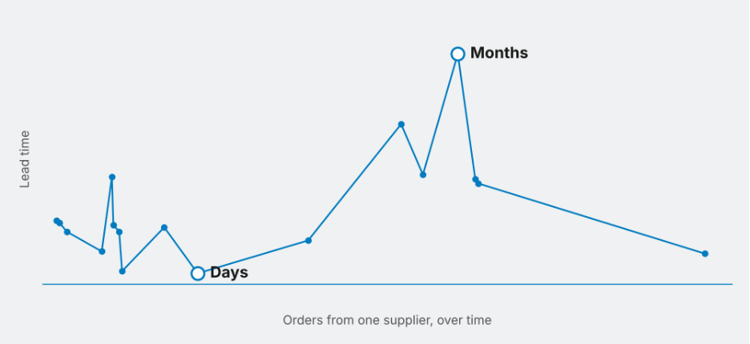
Lead times don’t only drift. They also swing. Orders from the same supplier can arrive in days one time and months the next. A single fixed lead time can’t cover that range.
Lead times from the same supplier can swing without warning. (Illustrative)
When shortages keep happening, the natural fix is to add more safety stock. It feels safe, but it treats the symptom, not the cause.
The cost shows most clearly in maintenance stock, where demand is the most irregular. Industry estimates suggest 50 to 60% of maintenance inventory at typical operations is excess, obsolete or slow-moving. Yet unavailable spare parts are still behind 23% of unplanned downtime events.
The answer isn't more spreadsheets or more frequent manual reviews. It's planning that changes when the inputs change.
If a few of these sound familiar, it's worth looking at how your planning settings are calculated, and how often they change.
Inventory Intelligence, from Bosch Mobility Platform & Solutions, puts this into practice. It matches a machine learning model to each material’s demand pattern, predicts how long each supplier will actually take, and recommends updated reorder points, safety stock and order quantities. Planners review each recommendation with a confidence score and update their ERP in a few clicks.
Live in 60+ Bosch plants, it has reduced inventory by 10 to 20% against each plant's own baseline.
Want to cut excess stock without risking shortages? Talk to our team.